


Cloud system performance directly impacts customer experience, productivity, and revenue. Yet many organisations expect cloud platforms to handle this automatically with speed and reliability baked into their solution. They don’t.
Performance issues almost always trace back to the decisions made when designing a system, not to the cloud platform itself. Consistently fast, stable cloud systems are never accidental. They’re engineered.
How engineering teams optimise cloud performance for speed and stability
High-performing cloud systems are built through deliberate design, efficient use of resources, and continuous feedback.
Engineering teams drive cloud performance optimisation by designing for scale, removing bottlenecks, automating how systems grow and shrink with demand, and using cloud observability to tune systems against real-world traffic.
Rather than reacting to problems after they surface, mature teams practise performance engineering from the start, building speed and cloud stability in before the system is ever put under pressure.
Why cloud performance problems rarely come from the cloud itself
Cloud providers offer powerful, capable infrastructure. The problem is almost always how that infrastructure is used. The most common causes of poor cloud system performance aren’t platform failures, but rather engineering choices:
- Services that are too tightly connected or over-coupled, so a problem in one brings down others
- Inefficient data access patterns where data is being fetched in slow or inefficient ways that get worse under load
- Computing resources set to a fixed size that can’t flex when demand changes
- No real visibility into how the system is behaving
Performance debt builds quietly. By the time a team feels it, what looked like a cloud problem is almost always an architecture problem. Most cloud performance issues are engineered in, not imposed by the platform.
Architecture as the foundation of cloud performance
The decisions made before a single line of code is written set the ceiling for how a system performs under real traffic. Efficient cloud architecture isn’t an afterthought. It determines what’s possible later. Resilient cloud systems are built on:
- Stateless, horizontally scalable services: Individual services that scale independently, so growth in one area doesn’t bottleneck another
- Asynchronous communication: Design that prevents a slowdown in one part from stalling everything else
- Optimised data strategies: Data stored and accessed in ways that match how it’s used
- Proximity & caching: Processing that happens close to the users who need it
Scalable cloud architecture performance is largely decided at design time. Once a system is live, those early decisions are difficult and expensive to undo.
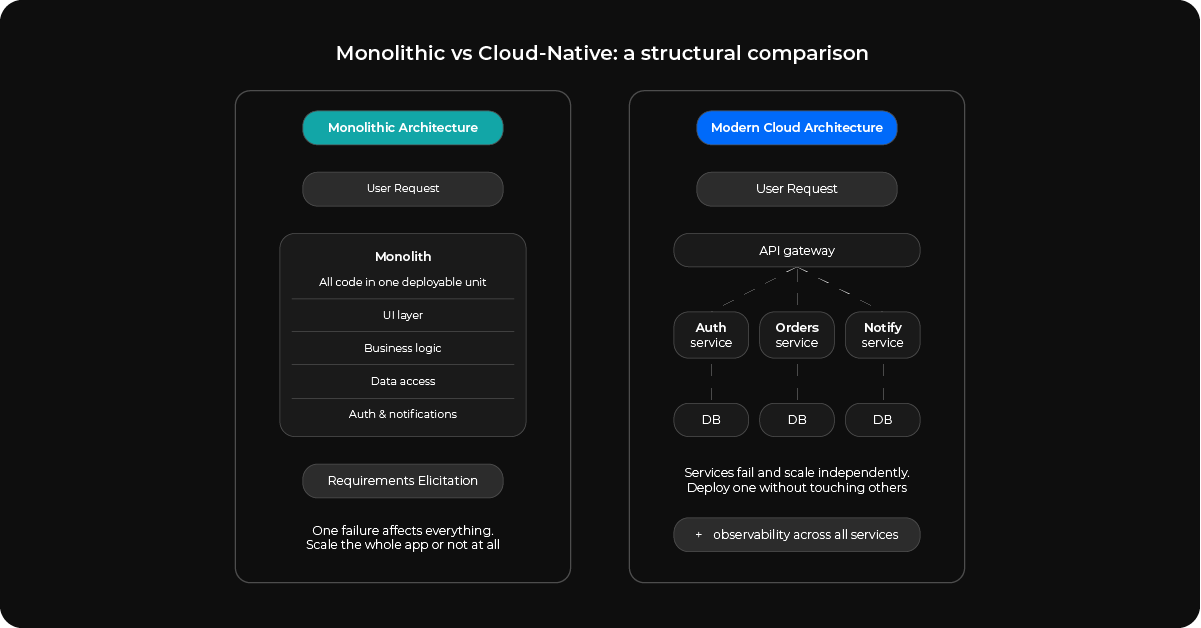
When cloud systems are faced with potential component failure, modern cloud architecture ensures that the system either degrades gracefully or recovers automatically, while monolithic architecture bring everything else down with it.
Efficient resource usage through elastic design
One of the practical advantages of performance cloud computing is that infrastructure can scale up or down automatically, but only when it’s watching the right signals. One of the practical advantages of performance cloud computing is that infrastructure can scale up or down automatically, but only when it’s watching the right signals. Elastic design means a system adjusts to match demand. Engineering teams achieve this by:
- Scaling up when traffic increases and back when things are quiet
- Matching computing power to actual workload rather than worst-case estimates
- Removing idle capacity without harming responsiveness
- Balancing speed, throughput, and cost across all conditions the system will face
Done well, this produces faster systems that cost less to run and hold up predictably as the organisation grows.
Observability and stability: engineering performance that lasts
Cloud performance monitoring is how a system gets better over time. Metrics, logs, and traces (the three core tools of cloud observability), give engineering teams clear sight into where a system is slow, where it’s struggling, and why. Metrics, logs, and traces (the three core tools of cloud observability), give engineering teams clear sight into where a system is slow, where it’s struggling, and why.
Cloud metrics and monitoring allow problems to be caught before customers are affected, and real usage data to feed back into design decisions rather than waiting for something to break.
Key insight: You cannot optimise what you cannot see!
That visibility is also what makes stability possible. The signals that reveal a bottleneck under load are the same ones that determine how a system should behave when a component fails; whether it degrades gracefully, recovers automatically, or brings everything else down with it.
Engineering cloud reliability depends on what observability reveals. Operational stability in cloud systems doesn’t happen by default. It is engineered in, using the same data that performance monitoring surfaces. Fast systems are meaningless if they are fragile.
Common mistakes that undermine cloud performance
Most cloud performance problems are avoidable. They follow the same patterns:
- Treating performance as something to fix later rather than design for upfront
- Relying on bigger servers instead of smarter architecture
- Ignoring how far data must travel and how it’s accessed
- Chasing symptoms instead of root causes
- Over-optimising for rare traffic peaks while neglecting how the system performs day to day
Catching these patterns early is far cheaper than correcting them once a system is under real load.
How BBD’s cloud engineering architects approach performance
BBD’s cloud engineering practice starts at the architecture stage and not after problems appear. Decisions are based on real workloads and growth patterns, not assumptions. That means:
- Engineering-led, architecture-first optimisation
- Cloud-native design with operational discipline built in from the start
- Continuous improvement rather than one-off tuning exercises
- Designing for real growth patterns, not best-case assumptions
Performance is not a project with an end date. It is a discipline built into how systems are designed, run, and improved over time.
Speed and stability are built, not bought
Cloud platforms provide the infrastructure. Engineering teams determine what that infrastructure delivers.
High-performing systems don’t come from choosing the right provider – they come from disciplined architecture, elastic design, and continuous cloud performance monitoring working together.
Teams that engineer for performance from the start avoid the firefighting that follows when it’s treated as an afterthought. That discipline compounds. Mature cloud engineering turns cloud reliability into a lasting advantage as the system grows.
If your team is looking to build performance and stability into cloud systems from day one, BBD’s consulting services can help.